terça-feira, 1 de junho de 2010

Happy International Children's Day!

(this in 2007) (change much?)

One of the key events realized in the context of the International Day to Eradicate Poverty was a Childrens’ Art Competition themed “We Can End Poverty” organized by the United Nations Department of Economic and Social Affairs in collaboration with the Department of Public Information and the United Nations Postal Administration.

In the context of the competition, over 12 thousand children from 124 countries designed United Nations stamps that illustrated many faces of poverty, concerns for the poor as well as children’s good wishes. The creative artwork of children depicted the existence of inequality and divisions of the world and emphasis was given to concepts of love and compassion. As a means to eradicate poverty, in their artwork, children suggested education, employment, peace and security. 15 year-old Sonja Mohr from Namibia said “Nobody should be imprisoned by poverty and violence. Education and reaching out to each other is the ladder to step out of poverty and into peace on a bright future”.

Following the decisions, 6 of the winning designs will be issued as United Nations stamps in 2008 while 20 designs were awarded Merit Certificates and another 24 designs received Certificates of Recognition. The 50 best designs on the other hand were displayed at the United Nations Headquarters in New York at a special exhibition on 17 October 2007. (To view the winning designs please click here)

segunda-feira, 31 de maio de 2010

At Play in the Field of the Mind


This monumental book—more than 900 pages long, 30 years in the making, at once grand and intricate, breathtakingly inclusive and painstakingly particular—exhaustively explores the biological evolution of human behavior and specifically the behavior of children. Melvin Konner, an anthropologist and neuroscientist at Emory, weaves a compelling web of theories and studies across a remarkable array of disciplines, from experimental genetics to ethnology. He ranges back to the earliest, egg-laying mammals, discusses topics as seemingly modern as cross-gender identity conflicts, and draws on scientific work examining all manner of species with which humans share distinct characteristics. (In the way we teach our young, for instance, Konner points out that we resemble cats large and small far more than we do our closer genetic relatives, the large primates.) The organization of these disparate puzzle pieces is itself a tour de force. Though the sheer volume of information and the not infrequent appearance of terms like synaptogenesis and N-methyl-D-aspartate glutamate receptor can be daunting, Konner’s style is conversational (if sometimes occluded) and his tone is, well, kind. To read this book is to be in the company of a helpful and hopeful teacher who is eager to share what he’s found.
Dividing the book into four often overlapping “levels of observation”—the genome, the nervous system, society, and culture—Konner assesses the development of the brain from the first vertebrates through the hominins, with their slow-growing, enormous, super-energetic brains. This development depended on a high-quality diet of fruit and then cooked foods, both plant and animal, and particularly aquatic fauna—not to mention the grandmothers and other “helpers at the nest” who ensured that children were fed. In fact, human brains are so large that were they to reach full size in utero, women’s bodies would not be able to deliver them. Much of the brain’s growth occurs after birth: the human brain more than doubles in volume during the first 12 postnatal months, and nearly doubles again over the subsequent 12 months. This means that infants, with their far from fully developed brains, are extraordinarily helpless for a long period after birth. One reason humans evolved into creatures that walked upright may have been so that mothers could carry offspring who could not yet cling to them.
Konner then explores the genetic and neurological foundations of basic temperament and gender identity and of formative behaviors such as infant attachment and the acquisition of language, and he describes the interrelationship between the biology and psychology of puberty. Unlike animals that hurtle from infancy to puberty, the humans who have escaped the risks of infancy but not yet embarked on the risks of adulthood experience a sort of mini-transformation during the “five-to-seven shift,” and emerge with markedly enhanced powers of cognition into a period of slow growth. This prolonged halcyon phase, sandwiched between the confusion of early life and the intensity of adolescence, seems evolutionarily designed to imbue children with the culture that our enormous brains make possible—the culture that our species (almost) alone can claim.
The sine qua non of culture is socialization, a process we share with many other species. For mammals, it begins with an extreme bond between mother and offspring—a bond that has existed since early in the age of the dinosaurs, when even the infants of egg-laying mammals could feed directly from their mothers’ bodies and demand attention by crying. (Mammalian young cried at high pitches that their mothers could hear but reptilian predators could not.) Although the mother-child bond forms the core relationship, we are cooperative breeders. There is “ample evidence,” developed most prominently by the pathbreaking anthropologist Sarah Blaffer Hrdy, that “human mothers have always gotten help” from fathers, grandmothers, older siblings, and other relatives. Still, some evidence suggests that kinship is not the be-all and end-all it is often believed to be. Research on the !Kung hunter-gatherer society, for example, shows no particular advantage to having a full complement of parents and grandparents, and in cases in which children have few kin, other adults apparently take up the slack, supporting the idea that indeed, it takes a village. Crucially, the many years that human females live after menopause confer a unique advantage on the species, in that grandmothers are almost always involved in child care, allowing their children, particularly their daughters, to produce more and healthier children.
Konner is especially interested in play, which is not unique to humans and, indeed, seems to have been present, like the mother-offspring bond, from the dawn of mammals. The smartest mammals are the most playful, so these traits have apparently evolved together. Play, Konner says, “combining as it does great energy expenditure and risk with apparent pointlessness, is a central paradox of evolutionary biology.” It seems to have multiple functions—exercise, learning, sharpening skills—and the positive emotions it invokes may be an adaptation that encourages us to try new things and learn with more flexibility. In fact, it may be the primary means nature has found to develop our brains.
Finally, Konner argues that even if culture is as subject to the laws of evolution as other aspects of physiology and behavior, it is, in its complex forms, unique to our species. (He does emphasize, however, that humans share with other animals a host of qualities and emotions—love, grief, altruism, heroism, loyalty, shame, dignity, awe, thought—that have wrongly been ascribed to humans alone.) Humans may not be the only ones who teach, but we alone create and build in a cumulative way, and we alone suspend ourselves in “webs of significance we ourselves have spun,” as Konner, borrowing from Clifford Geertz, elegantly puts it.
Ultimately, Konner is attempting to construct a sort of theory that encompasses all of human life. The evolutionary processes he describes are the way in which at every level—the genome, the nervous system, society, and culture—we, who carry along information accumulated over billions of years, continually interact with the environment, and thereby learn and change in response to it. Children, who are shaping and organizing their very selves, experience this most powerfully. And it should not be surprising, he speculates, if children—in the midst of the most exploratory phase of human life, thanks to “their huge, fast-growing, thoroughly dynamic brains”—have throughout the history of the species often been at the vanguard of cultural innovation.
This book is the flower of an astoundingly productive and innovative period of scholarship on evolutionary behavior; it sums up a generation’s worth of thinking and research. But although a work of singular importance, it’s not flawless. Konner’s efforts sometimes flag: his writing fails to sustain a consistent precision and focus. Relatedly, at times Konner seems overwhelmed by the encyclopedic nature of his project. When he sifts and assesses evidence, he’s always judicious and often brilliantly imaginative. Too often, though, The Evolution of Childhood reads like a compilation of research and findings rather than a work that distills that material to create an elegant synthesis—this book hasn’t been subjected to the rigorous and comprehensive editing that a work of such significance demands. But only a book of such staggering ambition can be faulted for failing to achieve consistent greatness.

sexta-feira, 28 de maio de 2010

What Can We Do About PVC, indeed...

(So cute. So filled with PVC)

Annie Leonard, director of The Story of Stuff Project, creator of the internet video sensation, and author of The Story of Stuff: The Book.

PG: Why is PVC at the top of your "worst offenders" toxins list? Why should we avoid it, and what are some better alternatives?
ANNIE SAYS: PVC is just one of many toxic materials in common use. But it makes me especially furious because so many safer alternatives exist! And it's the most toxic type of plastic at all stages of its life (production, use, disposal). Workers in vinyl chloride production factories have higher rates of liver cancer, brain cancer, lung cancer, lymphomas, leukemia and liver cirrhosis. Chemical additives in PVC, like phthalates (a group of suspected carcinogens and known reproductive toxins, which are put in PVC to make it more flexible) can leach out, migrating from toys into our children, from packaging into our food, and from our shower curtains into the air we breathe. Americans toss out up to 7 billion tons of PVC every year, with 2 to 4 billion tons of that going to landfills, where it leaches its toxic additives into the soil, water, and air. 

There’s no need to keep using it. If it was some toxic but life-saving material, then we could have a debate. But it just isn’t needed. Already dozens of companies have phased it out of products. Even whole cities have placed restrictions on it in Europe but it still permeates our homes, schools and hospitals (although many hospitals are phasing it out; visit Healthcare Without Harm for more information). 

Unlike other toxics that are added to a myriad of products, it is also easy to recognize PVC, so you can keep much – probably not all – of it out of your life. PVC containers are often labeled with a little 3 in a recycling logo on the bottom; get in the habit of checking. PVC is also readily identifiable by its horrible smell – think new shower curtain. Consider a fabric shower curtain instead of that plastic one. Store your leftovers in glass jars. Download Pass Up the Poison Plastic: The PVC-Free Guide for Your Family and Home

Whenever I do accidentally buy something (a new extension cord or a raincoat for my daughter) without realizing it contains PVC, I pack up the product and send it back to the manufacturer with a letter explaining why the product is unacceptable. If I can't find the manufacturer, I send it to the Vinyl Institute, an industry trade group in Washington DC. These guys make big bucks to defend the producers of PVC, so I figure they can deal with it. 

It’s toxic. It’s unnecessary. It shouldn’t be in our consumer products. You can help by joining the Poison Plastic Campaign led by the Center for Health, Environment, and Justice in New York City.


terça-feira, 18 de maio de 2010

segunda-feira, 17 de maio de 2010

quinta-feira, 13 de maio de 2010

Cutest thing in a very long time

Cats and kids (and Happy very belated Mother's Day)

(This map shows Mother’s Day celebration dates around the world, from iLoveCharts ;)


We had this great 10 year old cat named Jack.
Jack was a great cat, and the kids would carry him around and sit on him and nothing ever bothered him.
He used to hang out and nap all day long on an old mat in our bathroom.

Well we have three kids, and at the time of this story, they were 4-year-old, 3 years old and 1 year old. The middle one is Sam. Sam really loved chapstick. LOVED it! He kept asking to use my chapstick and then he'd lose it.
So finally one day I showed him where in the bathroom I kept my chapstick and how he could use it whenever he wanted to but he needed to put it right back in the drawer when he was finished.

Last year on Mother's Day, we were having the typical rush around, trying to get ready for Church with everyone crying and carrying on. My two boys were fighting over the toy in the
cereal box. I was trying to nurse my little one at the same time I was putting on my make-up. Everything was a mess and everyone had long forgotten that this was a wonderful day to honor me and the amazing job that is motherhood.

We finally had the older one and the baby loaded in the car and I started looking for Sam. I searched everywhere and I finally rounded the corner to go into the bathroom. And there was my boy.

He was applying my chapstick very carefully to Jack's . . . butt. Sam looked right into my eyes and said "Chapped."

Now if you have a cat, you know that he is right -- their little bottoms do look pretty chapped. And, frankly, Jack didn't seem to mind. And the only question to really ask at that point was whether it was the first or the hundredth time.

And THAT is my favorite Mother's Day moment ever because it reminds us that no matter how hard we try to civilize these glorious little creatures, there will always be that day when you realize they've been using your chapstick on the cat's ass.

terça-feira, 11 de maio de 2010

sexta-feira, 7 de maio de 2010

Livros Infantis para a Casa das Mães de Tires


Tenho agora este desafio enorme que é tentar que as reclusas da Casa das Mães de Tires, depois das celas se fecharem às 19 horas, se sentem com os filhos ao colo e lhes contem uma história.

Ao falarem comigo hoje, disseram que não sabem o que lhes hão de dizer ou contar. Provavelmente também nunca ninguém lhes pegou ao colo e contou uma história.

Pensei que, através da leitura de livros infantis, fosse mais fácil para elas estabelecer o contacto, intensificar os laços afectivos e estimular o desenvolvimento das crianças.
(...)
Lembrei-me então de lançar um apelo a quem  puder divulgar este pedido, junto de escolas, pais, associações, etc.
O objectivo é angariar  livros para crianças, filhas das reclusas, até aos 3 anos.
O meu email é paularamos@pessoascriativas.com . Se alguém estiver interessado em contribuir, poderá contactar comigo e eu farei chegar os livros à Casa das Mães.
Obrigada.

quarta-feira, 5 de maio de 2010

terça-feira, 4 de maio de 2010

Dot to Dot Wallpaper

Any age of child, teenager or adult will love this unusual wall covering. Just paste this original wallpaper to your walls in the usual way, then use pencils or pens to join up the dots to their heart’s content. You’ll all be amazed as the pattern begins to emerge!

Cox and Cox

quarta-feira, 21 de abril de 2010

Claro que é um Pastor Alemão / Of course it's a German shepherd


It was the dog trainer's honesty that won Lisa McMillan over.
When McMillan asked the trainer whether she was able to train a dog to assist with her autistic twin boys, the dog trainer said, "I don't know anything about autism."
The mother did. And Kelli Collins knew how to train dogs. Together, they would train and raise a puppy to be a companion to the then-3-year-olds, Eric and James. Collins would work with the puppy, Caleb, on learning the boys' scent so he could find them when they bolted. He soon would learn to comfort them, almost instinctively, when they needed a friend.
Autism, a developmental disorder, affects one of every 110 children, according to the Centers for Disease Control and Prevention. People with autism often have social, communication and behavioral challenges, but to varying degrees.

Collins is a trainer for the Georgia K9 National Training Center in Canton, Georgia. Collins, with her partner, Jeff Schettler, started as a trainer for law enforcement and search and rescue dogs. She also teaches obedience to family dogs. She's been training dogs for 15 years.
The pair trained Caleb at the center's indoor and outdoor facilities, the family's home and out in social settings. They fused their search and training techniques for finding missing people with handling a child who can bolt in an instant. They taught Jennifer Fair, who lives with the McMillans, how to give directions and encourage positive behavior with the puppy in the home and on outings.
"You can create physical disability in a training environment, you can't create autism. There's so many varying degrees of autism. Each child is a little different. Even between your own children, they are very different. We can't create that in a sterile training environment," Collins said.
The pair had to learn how autistic children thought and acted. This was their first service dog. They even made a tether for Eric, inscripted with his name and stars, because that personalized the belt and made it his. Soon the training became natural for the trainers, Schettler said.

"The first time we took Caleb out and he was tethered to [Eric], the sense of freedom that child had was amazing. He was happy," Collins said. "And he never tried to really even bolt. One time we were sitting outside at a café and he went to get up and run and Lisa's first instinct was to jump up and I'm like, 'Let the dog do his job,' and the dog stayed. Eric couldn't go. She's like, 'He would've been around the corner and down the street now.' "

The training of puppies -- environmental, obedience and service -- starts at 8 weeks old and continues on for the first 1½ years of the puppy's life, Schettler said. The puppies go with the trainers everywhere -- the grocery store, post office and restaurants. Georgia K9 places the puppies in homes when the puppies are between 10 and 16 weeks old.
"We find the bonding and everything that the dog does at this age becomes second nature to them. It's almost hard-wired in."
For families or individuals looking for a service dog for autism, Collins recommends finding a program that gives not only the training, but follow-ups and continuing guidance to help with the life transition of having a service dog. The training of service dogs for autism can cost anywhere between $15,000 and $25,000. 

As an occupational therapist, Amy Johnson has been working with the brothers on their life skills and challenges. She said Eric and James at first wanted little to do with the puppy but soon grew to embrace him.
"One of the best things is seeing how Caleb helps the boys in terms of safety," Johnson said. "Whether they are tethered to Caleb or tied to him, they can take them out in the community and I think for the boys, Caleb is a sense of security and comfort and it helps keep them grounded, but at the same time it gives Mom and Dad the relief knowing that they are tied to Caleb and can't get away."

Johnson said traditional therapies are still necessary, but one of the most important things is carrying therapy over into the home. That's where the service dog helps, she said.
"I think families [dealing with autism] want to always try anything they can and try anything that might work when you don't have a cure and you don't have any answers. This way it's getting a pet for your family that's a safe pet and a pet that's there to really help with your child and grow with your child."

terça-feira, 20 de abril de 2010

segunda-feira, 19 de abril de 2010

Ai que já não há bacios, quanto mais penicos!

A potes

Pergunto a mim próprio quantas crianças, de norte a sul do País, conhecem o bacio ou penico por pote. Avalio por mim, que, por uns breves instantes, fiquei perplexo perante o título Ruca Aprende a Usar o Pote, mais um título da infindável colecção referente a esta personagem da série televisiva. Tão perplexo como a personagem quando vê o objecto: «O Ruca pegou no pote e colocou-o na cabeça, para imitar um chapéu.»
A ficha técnica ajuda-nos a perceber tudo: o título original é Caillou — Le pot. A tradução e adaptação é de Sara Costa, a quem mando este recado: segundo certos estudos (Rice e Wexler, 1996, e Restrepo e Kruth, 2000, v. g.), a omissão do pronome possessivo é uma marca clínica de crianças com distúrbio específico da linguagem — mas de crianças falantes do inglês e do francês! Os tradutores portugueses devem desbastar, se querem escrever português de lei, os pronomes possessivos, marca sobretudo do inglês. Os revisores devem acompanhá-los ou substituí-los nesta nobre tarefa. 
Assim Mesmo-

sexta-feira, 16 de abril de 2010

Animal eyes quiz: Can you work out which creatures these are from their eyes?


........................................................................................................................................................................................................................................................................................................................................................
Top row: 1 Bengal tiger. 2 Asian elephant. 3 Zebra. 4 Chimpanzee. 5 Flamingo.
Second row: 1 Domestic cat. 2 Hairless sphynx cat. 3 Grey wolf. 4 Booted eagle. 5 Iguana.
Third row: 1 Macaw. 2 Jaguar. 3 Rabbit. 4 Cheetah 5 Horse.
Fourth row: 1 Lioness. 2 Bearded dragon (a type of lizard). 3 Leaf-tailed gecko. 4 Macaroni penguin. 5 Alligator.
Fifth row: 1 Great horned owl. 2 Mountain lion. 3 Boa constrictor. 4 Pufferfish. 5 African crested crane.

Wanna Suck Face?

The Art of Johan Thörnqvist

Website, and this thanx to Papel de Lustro ;)


quarta-feira, 14 de abril de 2010

Light for Malawi

and it's beautiful ;)


A solar-charged light might seem like just another green gadget to the average American, but for families in rural Africa, it could prove revolutionary.
Product design consultancy Plus Minus Design is vying to replace unsustainable and potentially dangerous lanterns in the homes of off-grid Africans with the Solar Pebble. Engineered with the economic constraints of developing-world citizens in mind, the Solar Pebble will provide one hour of LED light for every two hours of charge, and will cost only $2.70 to manufacture.
Plus Minus Design, based in Leeds, U.K., was founded by three undergraduate students at the University of Leeds. While studying product design and engineering, Adam Robinson, Henry James, and Tom Eales were given the opportunity to work with SolarAid, a charity in the U.K. 
SolarAid, which works to fight poverty and climate change, worked with the students to develop a solar-powered alternative to kerosene lanterns. Those lanterns, commonly used in rural Africa, draw 20 percent of an average Malawian family's income, SolarAid said, and pose respiratory health problems, as well as create fire hazards.
The undergrads spent months researching life in Malawi to design a product that addressed the needs of rural families, but also took environmental, economic, and lifestyle factors into consideration. Local maintenance, potential for the development of children's education, and adaptability to charge other devices were the team's key requirements. 
Though mobile phones and portable radios are common in rural Africa, individuals must travel to locations with mains power for charging. With this issue in mind, the engineers designed the Solar Pebble to charge phones and portable devices in addition to providing light.
Plus Minus Design was also able to address the need for local maintenance with a simply designed product assembled through snap-in parts and repairable with basic tools.
The Solar Pebble provides light and a means of portable charging, but its implications are even greater. The lamp will ship partially assembled, providing jobs for locals who would finish assembly. Furthermore, Plus Minus Design hopes the lamp will increase radio usage, providing rural African families with HIV/AIDS prevention information.
According to Robinson, the Solar Pebble will launch in Uganda and the U.K. by midsummer.

Solar Pebble could light the way for rural Africans


terça-feira, 6 de abril de 2010

domingo, 4 de abril de 2010

quinta-feira, 1 de abril de 2010

Teatrinhos de Papel

coleccionados por Lucía Contreras Flores
(graças ao Papel de Lustro, obrigatório ;)

sexta-feira, 26 de março de 2010

quarta-feira, 24 de março de 2010

terça-feira, 23 de março de 2010

a very important subject to any man who hopes to negotiate fatherhood with his sanity intact

I took my 6-year-old daughter to a birthday party yesterday, and fell into conversation with another middle-aged dad (of a 5-year-old girl) about strategies of paternal self-defense in relation to our children’s DVD diets. This is a very important subject to any man who hopes to negotiate fatherhood with his sanity intact, for reasons I’ll explain. Anyway, it took us about five minutes to discover that our respective sprogs shared an abiding fascination with Stanley Kubrick’s 2001: A Space Odyssey, and that both had even given it the same alternate title : “The Space Movie.”

Chuck, the guy I was talking to, told me he’d had equally great results with Dr. Strangelove. I told him that just wasn’t going to work for me, because my daughter has zero patience for anything in black-and-white (on the grounds that it “looks too old”), but that I’d gotten a solid 6 weeks of protection from O Brother, Where Art Thou? which, a couple of mild cuss words aside, makes for topnotch, high-repetition kiddie fare, and that I’d found both Hello, Dolly! and Singin’ in the Rain to be both worth their weight in unobtanium. 

Before I take this any further, I want to make clear that I’m not indulging myself in any Neal Pollack-style Alternadad bullshit here, nor crowing about how unbelievably brilliant my progeny is (although she is, of course, unbelievably brilliant). I’m talking about issues of stark survival, from a viewpoint of narrowest self-interest. 

Under enhanced interrogation, I might even admit that the scene in 2001 where the one ape clubs the other to death might be construed as just a tad violent for a 4-year-old, which I think is how old my daughter was when I first showed her “The Space Movie.” But I’d also have an array of counterarguments at the ready. 

First, she’d already been digging on Hellboy for a year by that age. 

Second, the psychological impact of that one fatal beating is surely evened out by the ensuing, math score-enhancing sequence of the space shuttle docking with the space station to the uplifting strains of The Blue Danube

Third, and most important, the deleterious effects of a single monkey murder (even if witnessed a few hundred times) is nothing compared to the potential negative impact of being raised by a father suffering from high-dose exposures to the likes of Alvin & the Chipmunks: The Squeaquel, Milo & Otis, Baby Geniuses and all the rest of the awful crap that it is my solemn duty to protect her from her interest in/affection for. 

Mind you, the problem isn’t just shrill, cynical Hollywood Twinkie-filling like the aforementioned. Some of the most maddening programming aimed at kids today is actually to be found on nominally instructive and improving cable venues like Nick Jr and PBS Kids Sprout. If you don’t know what I’m talking about, you are probably unfamiliar with the vocal stylings of Moose A. Moose and Laurie Berkner, the hushed, pious moralizing of animated series like Arthur and and Hey, Franklin, or the crazy-making Dadaist repetitions of Dora the Explorer and Blue’s Clues

My point is, young-fathers-to be, it’s fucking jungle out there, and once Scooby-Doo 2: Monsters Unleashed comes into your house, it’s going to be about as easy as bedbugs to get rid of. And unless you and your missus can afford to hire a full-time, Montessori-trained nanny/laundress/cook/masseuse, you will inevitably and routinely find yourself backsliding into that most unforgivable of parental sins, using the television as a babysitter

But there’s no reason to pay for that sin here in this lifetime.


domingo, 21 de março de 2010

Dia Mundial da Poesia e da Árvore


Quem planta uma floresta
planta uma festa.
Planta a música e os ninhos,
faz saltar os coelhinhos.

Planta o verde vertical,
verte o verde,
vário verde vegetal.

Planta o perfume
das seivas e flores,
solta borboletas de todas as cores.

Planta abelhas,planta pinhões
e os piqueniques das excursões.

Planta a cama mais a mesa,
planta o calor da lareira acesa.
Planta a folha de papel,
a girafa do carrocel.

Planta barcos para navegar
e a floresta flutua no mar.
Planta carroças para rodar,
muito a floresta vai transportar.
Planta bancos da avenida,
descansa a floresta de tanta corrida.

Planta um pião
na mão de uma criança:
a floresta ri, rodopia e avança.


Luísa Ducla Soares no FB ;)

sexta-feira, 19 de março de 2010

Mathematical Curiosities and Treasures

[and the Professor wrote books on the science of Terry Pratchett's Discworld, no less]
[and this priceless tagline in one of the book's jacket cover:

Forget Sudoku. For keeping your brain limber, nothing can compete with Professor Stewart's tasty assortment of numerical nibbles.


In his quiet way, Ian Stewart may have done more for his subject in these two books than he or his colleagues have done in perhaps the previous 10 or 15 books about mathematics I have read. One has to allow for that warmth towards a book just finished, but I might still feel the same a week or a fortnight from now.

There is no story in these books, no moral, no parable, no implied rebuke for my failure to master the calculus or to remember the difference between a prime and a Mersenne prime. There is only delight and amazement, and of course a tiny bit of entirely self-induced guilt at my own sluggard response to mathematical challenge.

For those who haven't yet looked at them, they are ragbags: almost random jottings of little puzzles, jokes, oddities, anecdotes, commonplaces and calculator curiosities collected over a lifetime. Did I read every word? Probably not. Dippers like me do tend to miss the occasional treasure. And no, I didn't try to solve all the puzzles, but yes, I did get some of them right.

I kept dipping into these books when I was supposed to be reading Jared Diamond's Guns, Germs and Steel. I dare say I shall still be picking them up when I get around to finishing Gibbon's Decline and Fall of the Roman Empire. The entries are short, comprehensible, delightfully distracting and deceptively frivolous.

When I first opened Professor Stewart's Cabinet of Mathematical Curiosities, the first thing I saw was the story about how the Indiana state legislature had passed a law fixing the value of pi. Why not? My school had in effect implemented a law fixing it at 22/7 or perhaps 3.14 (actually I think the first value was at primary school, the other at secondary school, as we went from fractions to decimals). Given that at some point you have to tell an examiner the area of a circle, you need to settle on a value.

But as Stewart points out, firstly it's a myth – also told about Iowa and Idaho – and secondly, the consequences of a "legal truth" (a legal limit on pi) that isn't in fact a "true truth" would be judicially absurd (turn to Cabinet page 25 for the consequences in theorem form).

Stewart can say this with conviction because, as his entertainments confirm, mathematics exposes the reality beneath the semblance of reality that most of us are happy with. There are hundreds of these confections and all of them are presented with an effervescent enthusiasm and good humour missing from the morose maths lessons of my own schooldays.

Some of the charm comes from the telling. I don't know why those recurring postulants the Great Whodunni and Grumpelina are more palatable starting points than A and B; and why Farmer Hogswill and Pigasus, his prize pig on a rope (Cabinet, page 143) seem more easy to manipulate than a blackboard theorem involving an equilateral triangle, but they are.

The other enticing thing about these books is that they are not just an alternative to the cryptic crossword or sudoku. They contain, in snack-sized servings, nourishing bits of intellectual history: Fibonacci series, Fermat's last theorem, chaos theory, the four colour problem, what Byron wrote about Newton, Euler's conjecture, public key cryptography, the inventor of the equals sign, Zeno's paradox, how the Babylonians handled number, the probability theory of monkeys and typewriters, the square root of minus one, celestial resonance and how the Egyptians did fractions with hieroglyphs (not a problem that I'd ever thought about before).

The entries are not all brief: Stewart's discussion of global warming (Hoard, page 164) goes on for pages, just after what Stewart claims is the shortest mathematical joke ever (but you might quarrel with the word "joke").

And how nice to be in a world where e is a Napierian exponent and not a recreational drug, where sliced bread comes in perfectly spherical loaves, and where proverbs become "tautoverbs". Example: If pigs had wings, they'd have wings; they still wouldn't be able to fly, because aerodynamics has laws to stop that sort of thing, but since this is Ian Stewart, the non-flying pig has to become an "unfeasible porcithopter".

My argument (am I the only one to think this?) is that while a little learning may be a dangerous thing, bite-sized ingestion might help some of us chew gratefully on such provocations. Instead of making a three-course meal of one theme in mathematics, Stewart has served up the instructive equivalent of a Michelin-starred tasting menu, or perhaps a smorgasbord of appetisers. And of course, appetisers are designed to give you an appetite for more.

Sometimes the most arcane dish is spiced with even more arcane flavours: a preposterous anecdote from Snorri Sturluson's Heimskringla (Hoard, page 223) is accompanied by two footnotes on the identities of Olaf, Olof the Treasurer, and Sigrid the Haughty.

I had, of course, come across Fibonacci and Fermat and quite a few other mathematical stars before, often in Stewart's earlier books, but these bits of semi-detached instruction seem a lot more reader-friendly when surrounded by unexpected titbits and not-so-silly jokes. For instance, in Hoard page 139 – between a short history of the square root symbol and a description of the ham sandwich theorem – is a tiny little squib headed "Please bear with me.

Q. What's a polar bear?

A. A Cartesian bear after a change of co-ordinates."

Yes, I'm still thinking about that one.

terça-feira, 16 de março de 2010

A Cat!

segunda-feira, 15 de março de 2010

A Tabuada / Times Tables

Click to compute ;)

Why do times tables matter - and how should they be taught?

The question above is half asked by me, and half by my 8-year-old daughter. She is currently learning her tables, and wondering why they are important. I've told her they're vital, but she remains unconvinced (er, the cheery phrase, "times tables suck" was written on a piece of paper left on the breakfast table one morning last week.)

I, on the other hand, remain convinced that tables really do matter, both for extending maths ability and for life outside the classroom. They can help, as I've tried to explain to her, from working out how much money you need to buy something, to measuring a room for a carpet (not that appealing to a child, I do realise). They're also important for recipes - what if you need to double or triple the quantities? - and for saving time. If you know your tables, then you're ahead of the game.

Clive Portman teaches Year 5 at primary school (that's 9 and 10 year olds). He says that tables are vital, because if you don't know them, you can't do the maths that follows. It sounds obvious, but it's so important. If you don't know your tables, you risk being lost when maths gets a bit more difficult. Clearly, you need to know what these tables mean, and how to apply them, but I don't think that's really so hard (groups of numbers, anyone? Or why not use the plastic cups method shown on Monday night's Dispatches programme?)
"Learning their tables is also good for a child's self-esteem," adds Mr Portman. "We find that parents often see them as an indicator of how good their child's maths is."

Adam Creen, head of maths at a secondary school, Salesian School, in Surrey, agrees that tables are crucially important. "They're used all the time," he says. "Half of the GCSE still needs to be done without a calculator, and knowing your tables speeds everything up. It's important for squares, square roots and powers. And, of course, you use them out of school, in all sorts of jobs too."

Peter Watt, a fellow secondary school maths teacher backs this up. "Remember that numbers and algebra are connected, so from a secondary teacher's viewpoint, this basic understanding of numeracy allows the pupils to engage in much deeper, more abstract maths beyond just counting," he says. "So, if you are confident with your numbers, then the fun stuff like algebra becomes instantly more accessible. Take for example the simple problem, I buy 8 albums for £24, if they are all the same price how much is each one? Which is just a wordy way of saying 8a = 24, what is 'a' worth?

"Confidence with numbers breeds confidence in maths, if you are stressing about 6 times 3 then you will struggle to access the other topics."

So, multiplication tables are important, and not just in an abstract sense, but for educational achievement and life in general. My daughter appears to be slowly coming around to this, as we have begun pointing out when we use tables in everyday life (usually concerning money!). She has also realised that division is so much easier if you can do multiplication, something she didn't seem to have picked up before.

The Conservatives are thinking of making all children take a tables test in primary school (possibly instead of KS1 Sats), so I wonder why our children often don't seem realise how important they are. Is this partly because they're taught in so many "fun" ways these days, they don't want to buckle down and actually learn something by heart (I do realise that makes me sound very old-fashioned)?

So, how should tables be taught? There seems to be much less of an emphasis on learning by rote now, although I actually think this is a good way to learn some things. As I mentioned above, I'm unconvinced  that everything at school needs to be desperately imaginative, or fun. 

Adam Creen, however, says that he's not convinced that rote learning is best for everyone, and at a recent workshop at my daughter's school, we were told that as learning by rote only worked for around 80 percent (!) of children, it wasn't particularly encouraged. The problem, as I see it, is that you simply need to know your tables. If you are having to work them out by adding up each answer (2,4,6,8,10 etc), you will find it a very hard and slow process.

I'm joined in my views by Clive Portman, who says that he "strongly believes in the rote learning" and by Dina Strasser, an American teacher (and blogger) who tells me that the same issues are talked about in the States. "I learned mine (late 70s early 80s) by rote, with much angst,  Mom tells the story of coming upstairs to hear me reciting them worriedly in my sleep," she says. "My daughter isn't old enough to have hit them yet, but I can say from the math she's bringing home and the math my 7th graders are learning, there's a tension between rote learning and more conceptual, investigative learning that continues in the US-- and not just in math, but in all subjects."

However, Dina adds that "for all its dreadly drill-and-kill feel, I feel that some thing are just worth memorising - as well as understanding. I'd put the times tables amongst the very few pieces of knowledge that are."

So I'm all for learning tables and there are many ways to do this. Peter Watt recommends playing Brain Training to practice, and there are loads of times tables games on the internet, not to mention CDs (we liked times tables disco and also learnyourtimestables, though some of it is a bit strange...). 

But I do realise (as mentioned in that 80 percent comment above) that some children do find times tables extremely hard and need more help with them. This is what prompted Penny Topsom, who's severely dyslexic, to come up with a new way to teach them to her children (who are also dyslexic).

"I had a fear of maths, a real problem with it," says Penny. "So when I had to help my sons with their tables, and one of them pointed out that the list of tables I'd produced didn't look like a 'table.'. I decided to change the way they were written and come up with my own version."

Penny's grid produced patterns to the tables that she didn't realise existed before. Suddenly maths began to make sense.

She has now written a book about her method, called "Multiplication rules" and she adds: "whether a child should be answer them instantaneously, with a teacher and an entire class staring at them, I'm not sure. Most of us when put under pressure, panic and go completely blank  and this is where I think most peoples' dread of times tables comes from. I'm sure it was this that made me few like a complete 'maths numptie' never once being able to answer these question!"

However, despite this, she agrees that kids simply need to learn to multiply. "I could never get a grip on the times tables when I was growing up," she says, "but now I realise that if you understand them, it makes fractions a lot simpler, and division. In fact, every part of maths seems to come back to them. I never understood why I needed to learn them at school, but now I do."

~


domingo, 14 de março de 2010

Pão!

Embrace Life


Via JC no Twitter ;)

sexta-feira, 5 de março de 2010

Food and Children's Books

 
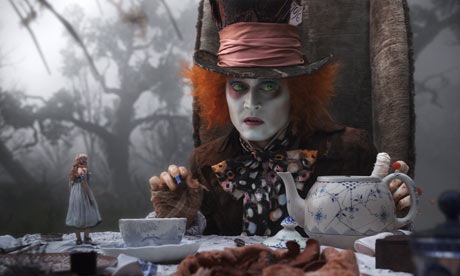
Tim Burton's Alice in Wonderland is released today, the latest adaptation of Lewis Carroll's books. Alice in Wonderland and Through the Looking-Glass are packed with descriptions of food: treacle wells, wine that doesn't exist, jam you can have tomorrow but never today (so you never actually get to eat it) and the Bread-and-Butterfly, which lives on nothing but weak tea with cream in. If it can't find any, it will die. ("'But that must happen very often,' Alice remarked thoughtfully. 'It always happens.'")
There's much to learn from food in children's books. Starvation was all too often inevitable in Victorian society, even if your diet wasn't limited to weak tea and cream. Plus Alice needs to be more sensible. Eating cake you've just found because it says 'EAT ME'? Drinking out of a strange bottle on the grounds it's not labelled "poison"? It's hardly clever. But kids in literature are far too keen to accept treats from strangers – just look at Edmund Pevensie in The Lion, The Witch and The Wardrobe. Turkish Delight is his downfall. Will he sell out his siblings for a quick sugar rush? Why, yes he will.

CS Lewis filled his books with religious imagery, so one line of thought says Edmund's face-stuffing is simply a warning against temptation, a caution against being lured by the sins of the flesh. It's also an effective warning against gluttony and stranger danger. Think before you scoff and don't take sweets from people you don't know, especially if you're lost and / or have just emerged from a magic wardrobe. You might find they've cancelled Christmas.
The greedy, grabby kids in Roald Dahl's Charlie and the Chocolate Factory meet stickier fates, though: Violet Beauregarde turns into a blueberry, squirrels push Veruca Salt down a rubbish chute and Mike Teavee gets put through a gum stretcher. So if you're going on a day trip, don't be greedy, nosy or disobedient. In fact, to be on the safe side, just don't eat, breathe or touch anything.
My friend Kat was traumatised by Enid Blyton's The Magic Faraway Tree: "I'll never forget Dick getting punished for breaking off a barley sugar door knocker in the Land of Goodies," she says. "I never looked at a door knocker in the same way again." Even Winnie the Pooh's beloved honey (or rather hunny) causes trouble in Pooh Gets Stuck: in another warning about the perils of over-eating, he fattens up on hunny and gets himself wedged in Rabbit's front door (Rabbit helps by hanging tea towels on his legs).
From warning against greediness and fussiness to the perils of sweet-wielding strangers, is there no such thing as an innocent snack in children's literature? Actually yes, there is. Look no further than the Moomin books by Tove Jansson. They are always nice to each other and they never seem to run out of porridge.

What food do you remember from children's books? Were you discouraged from eating it, or have you spotted any hidden messages you didn't notice when you were younger?

segunda-feira, 1 de março de 2010

Good news for anyone who may be looking for a present for a child they really like

The Weirdstone of Brisingamen is back in print! This is one of my all-time favourite books. Long after other childhood fantasy books have faded into the mists of memory, The Weirdstone stands proudly on my shelf, badly battered but hauled out for regular visits to the deceptive rural peace of Alan Garner's Cheshire.
With Colin and Susan (children of some indeterminate age between infancy and adolescence) I get off the train at Alderley Station, and am met by Gowther Mossock. We get into his horse-drawn carriage and go up the Edge, to the Mossocks' farmhouse, still lit by candles and lamps, for the Mossocks have not seen fit to change the way of life that suits them...
That is the beginning, and simple enough. Colin and Susan have been sent to stay with the Mossocks because their parents have been called away abroad. At first they -- and we, the readers -- see only the pleasant strangeness of their new home. But we are soon introduced to a deeper strangeness, yet so naturally that it flows out of the story as beautifully as the water of the Wizard's Well.
Garner, who besides being a writer of fiction is also a noted scholar of British folklore, tells us a story at the beginning of the book, a story about a wizard, and a sleeping king, and a farmer from Mobberley who had a milk-white mare. It's a true story -- or at least, a genuine piece of Cheshire folk tradition. And very soon, Colin and Susan discover just how true it really is, and how their lives have accidentally become interwoven with this great magic. For the wizard is real, and the cave where the King sleeps, along with a hundred knights on horseback, who, it is prophesied, will one day save the world.
This is not a typical Arthurian story, nor is it the usual story in which fortunate children leave this world for a more exciting one. Garner finds magic and mystery enough in his familiar English landscape, in the beautiful strangeness of Alderley Edge, in the maze of mines and tunnels that underlies Cheshire. The Weirdstone of Brisingamen, a magical stone lost for hundreds of years, has come into the children's possession and makes them a target for the servants of Nastrond, the dark spirit of Ragnarok. Their quest to return the stone to its keeper leads them on a desperate chase through the mines, and into a countryside transformed by a fierce and unseasonable winter. Colin and Susan, dragged bewildered into the magical country interwoven with their own, find themselves on an adventure more thrilling than they have ever dreamed of.
Yet what no review can convey is the solid reality of Garner's English landscape, and the way in which the magical creatures stand squarely on the ground with everyone else. In The Weirdstone of Brisingamen (as with its successor, The Moon of Gomrath) Alan Garner succeeds in the greatest magic of all: creating a world of imagination as absolutely believable as our own. 

Orchid or Dandelion?

Most of us have genes that make us as hardy as dandelions: able to take root and survive almost anywhere. A few of us, however, are more like the orchid: fragile and fickle, but capable of blooming spectacularly if given greenhouse care. So holds a provocative new theory of genetics, which asserts that the very genes that give us the most trouble as a species, causing behaviors that are self-destructive and antisocial, also underlie humankind’s phenomenal adaptability and evolutionary success. With a bad environment and poor parenting, orchid children can end up depressed, drug-addicted, or in jail—but with the right environment and good parenting, they can grow up to be society’s most creative, successful, and happy people.

Read all  The Atlantic