
terça-feira, 21 de maio de 2013


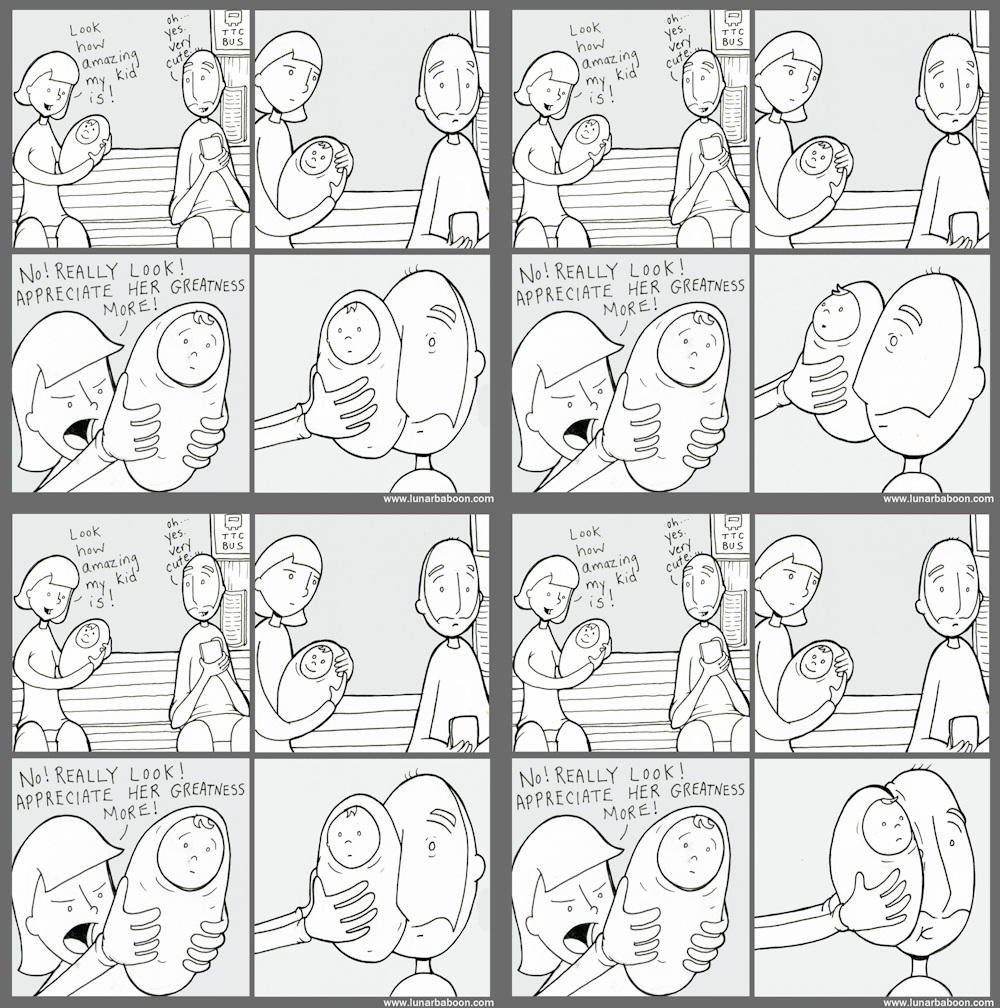
(still) On Mother's Day
In a child's eyes, a mother is a goddess. She can be glorious or terrible, benevolent or filled with wrath, but she commands love either way. I am convinced this is the greatest power in the universe.
- N. K. Jemisin, A Hundred Thousand Kingdoms

segunda-feira, 22 de abril de 2013

sábado, 6 de abril de 2013
TWO
Cake, partyyy - we were all so engrossed with friends and kids play that nobody cared about taking pictures (!) - and the Warrior Dad Best Host Ever resting at last :)


sexta-feira, 5 de abril de 2013
I am a velociraptor, hear me ROAR!!!
A hoodie sent by Grandma Kanguru, all the wayyy from Australia!


terça-feira, 2 de abril de 2013


terça-feira, 12 de março de 2013

quinta-feira, 7 de março de 2013

quarta-feira, 6 de março de 2013

segunda-feira, 4 de março de 2013


sexta-feira, 1 de março de 2013

quinta-feira, 28 de fevereiro de 2013
Toddler freak out, Dr. Harvey Karp and the caveman, bliss... :)

Last month, I discovered (and then nearly peed in my pants as a result of) comedian Jason Good’s blog post 46 Reasons My Three Year Old Might Be Freaking Out. (The first three possibilities: His sock is on wrong. His lip tastes salty. His shirt has a tag on it.) After exchanging a few comments on Facebook about it with a friend, she privately messaged me, frustrated with and concerned about her 18-month-old. “It's like all of a sudden in the last three weeks, she's turned into this tantrum ball and I never know what's going to set her off,” she wrote. “I'm living with a baby land mine!”
Me too. What is it with toddlers and losing their shit all the time? Is it normal that my son wails if his shirt sleeve isn’t all the way down, loves the bathtub one day but hates it the next, and manically screams “MINE!” two seconds after handing our dog a ball?
Yes, thankfully. And it’s not only normal, but reasonable. As five experts on child psychology recently explained to me, toddlers’ irrational behaviors are a totally understandable reflection of their inner turmoil and frustrations. In sum, their world is turning upside down and they don’t yet have the skills to handle it. Tantrums don’t mean your kid is a spoiled brat or needs therapy; tantrums mean he is normal.
The toddler life is not actually as cushy as it seems. Sure, I’d like 12 hours of sleep a night and all my meals prepared for me, thanks. But 2-year-olds are also going through a hellish personal crisis: They have just learned how to walk and use tools, so they really want to explore the world; at the same time, they are terrified of what that world contains and constantly fearful that their parents, whom they love and trust to a terrifying degree, will suddenly abandon them. Oh, and those same parents? They’re suddenly barking “no” all the time, seemingly just for fun. What the hell?
It’s no coincidence that kids start having tantrums around the time that parents start enforcing rules. When you say no, sweetie, you can’t have that butcher knife, your 20-month-old has no idea that you are depriving her of this awesomely shiny contraption for her own safety. “Since it’s the parent, whom they rely on for everything, who is taking it away, it’s perceived as a withdrawal of love, essentially,” says Alicia Lieberman, a professor of Infant Mental Health at the University of California-San Francisco and author of The Emotional Life of the Toddler. “They don’t know your reasoning. They just know that something they were getting great pleasure from, all of a sudden, you are taking away.” The pain that this causes, Lieberman says, is similar to what we might feel if our spouse betrays or cheats on us.
As adults, we (usually) don’t (audibly) freak out when we don’t get what we want or when somebody makes us mad because we can talk ourselves down. We can identify and label the emotion we’re feeling, which, research suggests, goes a long way toward quelling and controlling it. Our ability to label feelings stems in part from our excellent language skills, which young toddlers don’t have yet. Also thanks to language, as adults we can confront the people who are upsetting us and suggest solutions. My 22-month-old, though now very adept at informing me of his need for milk, doesn’t manage complex negotiations so well. His first response to frustration is generally to grab the nearest object and throw it across the room, which makes sense considering that his gross motor skills are among his strongest assets. If the only tool you have is an arm, you tend to see every problem as a potential projectile.
Another reality of the toddler brain: The frontal lobe, which is responsible for planning, logic, reasoning, working memory and self-control, is vastly under-developed. Because of this, “toddlers are really living in the moment, not thinking about consequences,” explains developmental psychologist Nancy McElwain, who runs the Children’s Social Development Lab at the University of Illinois at Urbana-Champaign. There’s no voice in their head saying, hmm, maybe it’s not a good idea to throw my lovie in the toilet (too bad, because lovie got very wet in our house last week).
A semi-functional frontal lobe also means that toddlers have practically no sense of time and patience and therefore “experience wanting as needing,” Lieberman says—i.e., when they want a chicken nugget, they really, really need it NOW! They can also have a skewed sense of cause-and-effect, developing a paralyzing fear of the bathtub because what if they go down the drain, too? Finally, let’s not forget the importance of experience when it comes to handling challenges appropriately, says developmental psychologist Claire Kopp, co-author of Socioemotional Development in the Toddler Years. The 2-year-old, she says, simply doesn’t have any experiences to draw from.
If it sounds like I’m characterizing your beautiful, special, way-above-average toddler as animal-like, that’s because I am. Pediatrician Harvey Karp, author of The Happiest Baby on the Block and The Happiest Toddler on the Block, calls toddlers “little cavemen.” “That is not meant to be derogatory, but meant to set the frame of reference for parents,” he explained to me. “It takes years to socialize our little toddlers, so it’s important for parents to cut themselves some slack. Don’t feel you’re a terrible parent because they smeared jam all over the walls.” (This is not to say that toddlers don’t also love organization and routine; they do. My son lines his toy cars up in a row every day, probably because he’s trying to build some order into his chaotic, confusing life. And his sleeve-down requirements may stem from a desire for consistency.)
The caveman analogy helps to explain yet another issue plaguing toddlers, Karp says: They are very under-stimulated. Little cavemen (and here I’m talking about the real ones) spent their days very differently than kids do today. “It was a sensory-rich environment: smells, the fresh air, shadows, birds, grass under your feet. Today, we put our little kids in houses and apartments with flat floors, flat walls, ceilings, and not too many chickens, and we think that’s normal,” Karp explains. “It is hard to spend all day with a two-year-old, and they don’t really want to spend all day with you anyway.”
Given all this, is it really that surprising that tantrums happen as frequently as they do? There are certainly good and bad ways for parents to handle poor behavior (an issue for another column), but the existence of tantrums, and the tendency for toddlers to tackle their woes through screaming and hitting and throwing, is perfectly normal because it’s sometimes “the toddler’s only recourse,” says Tovah Klein, director of the Barnard CollegeCenter for Toddler Development. If your universe were amazing and terrifying and frustrating and unpredictable, and you didn’t have good communication skills or a whole lot of experience or much of a frontal lobe, you’d freak the fuck out every once in a while, too.
quarta-feira, 27 de fevereiro de 2013

terça-feira, 26 de fevereiro de 2013

segunda-feira, 18 de fevereiro de 2013

quinta-feira, 14 de fevereiro de 2013
sexta-feira, 8 de fevereiro de 2013

quarta-feira, 6 de fevereiro de 2013
High Five! 5 anos 5 :)
A good day :)
Chocolate cake at school with friends, another chocolate cake at home with Daddy.
Party next Sunday (another cake :))) and more pics coming up!


quinta-feira, 31 de janeiro de 2013

segunda-feira, 28 de janeiro de 2013

quinta-feira, 17 de janeiro de 2013

sexta-feira, 14 de dezembro de 2012
quinta-feira, 6 de dezembro de 2012

quarta-feira, 5 de dezembro de 2012

5 ways to raise a grateful child

Your 9-year-old keeps a running -- and growing -- list of toys he has to have. He's up to number 23 this season.
In-The-Moment Fix: "Emphasize that you appreciate there are many things he wants, but let him know it will only be possible to get a few of them," says Robert Brooks, Ph.D., a psychologist at Harvard Medical School and coauthor of Raising a Self-Disciplined Child. That way, you won't make him feel greedy or foolish for compiling a lengthy list, but you will set his expectations.
Another idea: Ask him to make a second list, equal in number to the things he wants to get, of things or actions he is willing to give, suggests Maureen Healy, author of 365 Perfect Things to Say to Your Kids. For example: 1) Clean his room, 2) Help you find a charity that the family can donate to, 3) Pitch in when Dad starts wrapping presents, 4) Make a holiday card. Last, if you're in for belt-tightening this year, let him know.
Be honest, but keep it simple and undramatic so you don't scare him. Instead of saying "Dad might lose his job, so we have to cut back" -- which might make him sure you'll be losing the house next -- say something like "Nothing major is going to change, but we'll have to wait until next year to go on vacation and we have to hold off on getting the new bike you wanted." It's likely your kid will think "Okay, I can live with that," says Lerner.
Long-Term Strategy: Help him understand that gifts are thoughtful gestures, not just a way for him to score materialistic gain, says Lerner. Anytime he receives a present, point out everything the giver put into it. If a classmate makes him a friendship bracelet, for example, say "Oh, wow -- Lucy remembered that you thought these were cool. She picked out colors she knows you like, and it probably took her a whole hour to make. That is so nice."
Do this enough times and he'll get the "quality, not quantity" idea before you know it.
Your 5-year-old grimaces at the stuffed Elmo her aunt gives her and says, "But I wanted a Barbie!
In-The-Moment Fix: "The concept of hiding your own negative feelings to protect someone else's is way too complex for kids five and under," says Lerner. (Older kids get better and better but will still have frequent slipups.) So validate your daughter's feelings without responding critically, says Brooks.
Say "I know you wanted a Barbie, but let's think about all the different ways we can play with Elmo." You can also step in and model the appropriate response -- and defuse the uncomfortable situation -- by exclaiming something like "Wow, that was so thoughtful, wasn't it, Alli? Aunt Karen remembered you needed mittens!" This trick works for all ages: If your older son receives a gift he already owns, for example, say "Oh, cool! That's your favorite game!"
Write a little script for your child to follow when he gets a present, recommends Bette Freedson of the National Association of Social Workers. Come up with a stock line or two together, like "Thank you! I like it a lot!" He can also pick out one thing to specifically compliment ("This blanket feels really soft").
Long-Term Strategy: Before any gift-getting occasion, prepare your child for the possibility that she may not like all her presents, but at the same time, let her know that it's still important to show her appreciation. Remind her that people put effort into trying to find her the best thing. Then devise a special cue between the two of you, suggests Lerner, that reminds her to say thank you. When you see her mouth turning down, you can clap your hands and say "Great present!" to snap her back into good-manners mode.
You can't even take your kid to get socks or light bulbs without him whining for you to buy him something -- seemingly anything.
In-The-Moment Fix: Before you go on any shopping trip, inform your child that you'll be hitting the mall to, say, buy gifts for his cousins. "Engage him in the process," says Lerner. "Ask him what his cousin Jane likes and which toy you should get her. Get him excited about buying for someone else." At the same time, make it clear that you won't be able to buy anything for him. Then, if your son throws a fit at the store, you can refer back to that conversation, and say something like "I know it's hard to be here when you're not getting anything, but that's the rule. Now, I really need your help finding something for Jane." Let's be honest: That might not be enough to stop his whining. But steel yourself and stay strong. Caving in will only teach him that he will eventually get his way if he complains loud or long enough.
Long-Term Strategy: Your weekends may be errand time, but try to avoid spending all your family moments pushing a shopping cart. That way, your kids won't think acquiring stuff is the leisure-time norm. (Don't get us wrong, though: We know those flattering jeans are sometimes an absolute necessity!) Denver mom Beth Korin says she and her two boys, ages 7 and 9, frequently head to the library, an indoor pool, or a rock-climbing gym instead. "We try to think of things we can do that don't involve hanging out in stores," she says. Prepare kids for these events the same way you would for gifts ("We're going to have a big, delicious meal with all of your favorite foods, and then we're going to play games!"). The idea you want to get across is that having experiences can be just as exciting as accumulating things (if not more).
Your 6-year-old gobbles down the Teddy Grahams that another parent at the playground gives him. But when you prod him to say "Thank you," he won't.
In-The-Moment Fix: It's easy to turn this "teachable moment" into a battle of wills -- one where you're repeating "I didn't hear you say thank you!" to your tantrum-ing child while the person he's supposed to thank is backing away in discomfort. But, explains Lerner, the fact that your son doesn't always say the words likely just means they haven't become a habit for him yet. "And getting into power struggles actually impedes the process," she says. So while you should definitely remind your kids to give thanks, it's best not to make a big deal about it if it doesn't happen.
Long-Term Strategy: Remind yourself to model grateful behavior. When your cookie-muncher goes silent, go ahead and say the necessary "Thank you so much!" for him. (At least until he gets older and can be counted on to follow your cues.) In your own everyday interactions, always offer warm thank-yous and praise to grocery store clerks, gas-station attendants, waiters, teachers -- anyone who's helpful to you or him. You may think your child isn't paying attention to those small moments, but he actually is.
When you say no to a DS that, according to your daughter, "everyone at school" has, she complains that all her BFFs get cooler stuff than she does.
In-The-Moment Fix: Sympathize with her frustration, but remind your daughter that, actually, many people don't have as much as she does. How? Begin a tradition of charity work and donating. Start simple: As young as age 3, children can be encouraged to go through their belongings and pick out items to donate, says Lerner. Every year after that, they can get more involved. Last year, Gabrielle Melchionda of Yarmouth, ME, and her two sons, ages 5 and 9, volunteered to decorate low-income homes for Christmas. "It was so nice to see all of the kids, mine and those who lived there, on their bellies coloring together," she says. "Later, my kids asked things like 'Was that the whole house?' It sparked conversation for months. It was an experience none of us will forget."
Long-Term Strategy: Expose your daughter to people from all walks of life. "We often try to shield our children from those who are less fortunate, but it's important that kids know how lucky they are," says Dale McGowan, a father of three in Atlanta and coauthor of Parenting Beyond Belief. So the next time you see a homeless person, pass a shelter, or read a story in the news about a needy family, he suggests, ask questions -- "Where do you think that man sleeps?" or "Can you imagine what it would be like not to have a home?" -- that get your kids to put themselves in someone else's shoes. (At the same time, assure them that your family will always have a place to call home.) You'll be surprised -- and pleased -- at how often kids are moved to want to help.
Bonus mom advice: Don't diss gifts yourself as long as your little one is around. In fact, make a point of talking about the redeeming qualities of even that hideous necklace from your mother-in-law--how shiny! "You have to model gratitude if you want your child to practice it, too," points out Janette B. Benson, Ph.D., associate professor of psychology at the University of Denver.
quinta-feira, 22 de novembro de 2012


quarta-feira, 24 de outubro de 2012

segunda-feira, 15 de outubro de 2012


sexta-feira, 12 de outubro de 2012

domingo, 9 de setembro de 2012

sexta-feira, 7 de setembro de 2012
Why dinosaurs are important
by Dr. Dave Hone for The Guardian Science (and to be continued):
It is far from my intention to talk endlessly about dinosaurs on the Lost Worlds, but as a key part of my research and given the near endless public interest in them, they are going to keep coming up. I can assure readers that a more diverse set of posts will eventually turn up, but there are some good reasons to focus on the dinosaurs both in terms of thisscience in general and science communication in general, and that is worth dwelling on a little before I bore my readers with still more references to them.
I'll start with the issues of communication, outreach and education. With the odd exception of the children of palaeontologists, I've yet to meet a child who is not interested in dinosaurs, or at least used to be interested in dinosaurs. When I have the time and an invitation, I do give talks in schools and similar venues on dinosaurs and palaeontology, and am generally treated to a wonderful display of interest and an unending stream of questions afterwards.
There's a good deal of anecdotal evidence for this popularity, from the cheap plastic dinosaur toys that never seem to go out of fashion, the endless range of dinosaur books aimed at youngsters that appear year on year, and any new dinosaur exhibition can guarantee a queue around the block of children eager to see the new discoveries. I won't pretend to know why, but kids really do love dinosaurs and the important thing is that they do. (And let's not forget that there's no little interest from a great many adults too).
That provides a fantastic hook and instant introduction for palaeontologists and educators to get kids involved and interested in science. They might come for the giant bones, but there are a lot of good reasons for them to stay. Short of university, few people are likely to get even a cursory formal introduction to palaeontology, geology and the like during their education and moreover some things are not likely to generate much interest.
Few kids will (I suspect) willingly pick up a book on geology, perhaps not even one on general palaeontology, but most will probably own a dinosaur book or two at some point that will have been avidly devoured. Most of the better ones (even those aimed at younger readers) cover at least a little of how fossils are formed, different rock formations, the age of the Earth and the like, and thus they will be presented with at least a little geological information and there will likely also be parts on relationships between groups and changes over time thus introducing ideas about evolution, taxonomy and extinction.
In short, dinosaurs provide a wonderful way of talking to a young audience about all manner of scientific ideas and showing how things like geochemistry and biology can come together. They can also provide a great frame of reference for discussing issues in palaeontology. There might be better examples in the fossil record when discussing one issue in palaeontology or another, but one can all but guarantee that a good example on dinosaurs will be recognised and understood by the audience.
This then makes dinosaurs a superb educational tool and thus one that I'd be using here even if I didn't work on them myself, but dinosaurs are also inherently worthy of research. Well OK, any branch of science is inherently worthy of investigation as indeed is any group of organisms. It's perhaps better to say that dinosaurs do offer us some opportunities in palaeontological research that other groups don't necessarily offer. Thus while I wouldn't call them more worthy than other fossil groups, they're also going to be of interest to researchers who don't specialise in dinosaurs.
The modern terrestrial world is considered to be dominated by the mammals and this has more or less been the case since the demise of the dinosaurs (birds aside) some 65 million years ago. On an apparently unrelated note, the further back in time you go, the worse the fossil record (generally) gets. But together this means that if you want to look at a terrestrial fossil fauna that is not dominated by mammals, or the evolution of a non-mammalian group over time, or to examine a major extinction event and restructuring of a terrestrial ecosystem, or how terrestrial animals responded to the break up of the continents etc, the obvious place to turn to is the era of the dinosaurs. More recently it's pretty much all mammals. Further back the data is more patchy.
Similarly, dinosaurs were around for a very long time, and so for any kind of study of evolutionary change or diversity over a long period of time, dinosaurs are going to be a good candidate. Coupled to the fact that birds are dinosaurs and we have the opportunity to study a truly incredible and important piece of evolutionary history – the origin of powered flight – and of course gain insights into the origins and changes of the birds (themselves an important and diverse group).
Dinosaurs also include the largest terrestrial animals of all time in their ranks and so provide interest for biomechanics, the evolution of large size, the structures of ecosystems and more.
Finally, dinosaurs have already attracted a lot of research interest over the years, which means we know more about them than many other groups. While this does then become a bit of a self fulfilling prophesy, it does make them a better group for still further research or more integrated projects than some other groups as we're starting from a more solid base of knowledge.
Thus dinosaurs provide some unique research opportunities as well as more "normal" palaeontological research. Either way, though, their enduring popularity makes them a key part of the arsenal of the science educator. Kids love them and as such they are an ideal way of introducing children to other areas of science, especially those perceived to be "unsexy" or that might otherwise be overlooked.
I make no apology for my own love of dinosaurs, but I'd also be silly not to exploit their charisma and the instant recognition they bring. Non-dinosaur articles are coming, but expect more than a few that do involve them as the necessary educational relish to the beef of the Lost Worlds blog posts.
quinta-feira, 6 de setembro de 2012


terça-feira, 4 de setembro de 2012

quarta-feira, 20 de junho de 2012
segunda-feira, 11 de junho de 2012
quinta-feira, 24 de maio de 2012

quarta-feira, 9 de maio de 2012

Subscrever:
Mensagens (Atom)
