- Parents listed as “Producers”
- Variety of “Critic’s Quotes” about your baby
- Title of “movie” (can be anything you'd like)
- Date, time, weight and height of baby
- Doctor listed as “Director”
- Filmed in” the Hospital the baby was delivered
- Siblings, Grandparents, Godparents, Aunts, Uncles, Cousins
and ANY other special people who you want included - Made Possible with a grant by God
- “Catering” by the mother
- “Stories” by Mother Goose
- “Subtitles in ...” any additional language
- “Soundtrack” on Waaaahhhh!!! records
- Rated B for Boy, Rated G for Girl, or Rated T for Twins
- “Costumes” and “Props” listed
- “Now Showing” in your city of residence
(Choose whatever details are appropriate for you)
domingo, 16 de março de 2008
Ora que bela ideia!
sábado, 15 de março de 2008
quinta-feira, 13 de março de 2008
Fears / Medos
Fears: Ranked from childhood through parenthood
(with thanks to Ray Federman)
1. Fear of the dark
Under the bed.
Inside the closet.
Between leap and landing (floor to bed).
(Related) Long arm reaching out from under bed.
2. Fear of separation
Lost in a crowd (accidental).
Lost in a crowd (on purpose).
Lost in the woods (either).
3. Fear of abandonment
Parents dying.
Parents divorcing.
One parent moving.
Parents remarrying.
4. Fear of wicked stepparent
5. Fear of pee accidents
In school.
In bed.
In friend’s bed.
6. Fear of bras
Needing one.
Not needing one.
Anyone looking closely enough to know.
7. Fear of menstrual period
Getting it.
Not getting it.
Surprise attack.
8. Fear of embarassment
Wrong clothes.
Wrong hair.
Wrong glasses.
Wrong body.
Wrong mother.
9. Fear of Getting Pregnant
10. Fear of rejection
By friends.
By boyfriend.
By colleges.
11. Fear of being found out
12. Fear of not getting work
Not paying student loans.
Not paying bills.
13. Fear of selling out
Deserting dreams.
Embracing capitalism.
14. Fear of the dark (continued)
Parking lots at night.
Deserted streets at night.
Apartments at night.
Houses at night.
Bedrooms at night.
15. Fear of rejection (continued)
By lovers.
By bosses.
By friends.
16. Fear of being unloved
17. Fear of being unlovable
18. Fear of having married the wrong person
19. Fear of not getting pregnant
20. Fear of mortality
Parents’ mortality.
Spouse’s mortality.
Signs of mortality.
Cancer.
21. Fear of childbirth
22. Fear of losing a child
To crib death.
To falling down stairs.
To a head injury.
To bathtub.
To a bicycle accident.
To a car accident.
To a playground accident.
To a freak accident.
To pneumonia.
To cancer.
To a thousand kinds of cancer.
To a pedophile.
To a kidnapper.
To a babysitter.
To a stranger.
To a tick bite.
To a bad heart.
To thin ice.
To a swimming pool.
To falling rocks.
To drugs.
To gun violence.
To poor judgment.
To sport.
To a dare.
To driving.
To driving drunk.
To heartbreak.
To childbirth.
—Jan Pettit
terça-feira, 11 de março de 2008
segunda-feira, 10 de março de 2008
O teu primeiro álbum de Poesia
Nesta antologia encontra-se poesia criteriosamente seleccionada por Alice Vieira de autores como Luís Vaz de Camões, Fernando Pessoa, Miguel Torga, António Gedeão, Eugénio de Andrade, Sophia de Mello Breyner Andresen, Mário-Henrique Leiria, Ruy Belo, Luísa Ducla Soares, Matilde Rosa Araújo, Vasco Graça Moura, entre outros.
Cada leitor será livre de decidir aquele que prefere, aquele de que menos gosta, aquele que mais o encantou (mesmo que não tenha percebido as palavras todas), aquele que lhe pareceu mais estranho, aquele que aprendeu logo de cor.
As autoras Alice Vieira e Danuta Wojciechowska coleccionaram os poemas e conceberam as imagens deste álbum, que somos convidados a apreciar página a página e, no fi nal, a completar.
Trata-se de uma obra para leitura individual ou em grupo. Com ela se pode começar a amar a língua, a literatura e os livros numa aventura através da linguagem poética que envolve compreensão, imaginação e coração.
A vida emocional dos Bebés
(sou muuuuuito rápida, não esperámos assim tanto tempo :)
Agora resta ouvir o CD... Ainda andamos a ouvir Raimond Lap.
E temos que lhe dar com muito Mozart, sei lá ;)

O Teu Pequeno Nome aborda questões do desenvolvimento afectivo dos bebés durante o tempo de gestação e no primeiro ano de vida, destacando a importância das boas experiências emocionais precoces para um adequado desenvolvimento individual e social futuro.
Pensado para pais que aguardam a chegada do seu filho ou que lidam diariamente com as necessidades globais de um bebé, este é um livro que se destina a todos quantos se interessam pela promoção da saúde mental infantil desde os primeiros tempos de vida.
O Teu Pequeno Nome inclui ainda um CD com a interpretação da obra de Robert Schumann Cenas Infantis op. 15, pelo pianista Jorge Moyano.
sábado, 8 de março de 2008
Estou passada
How often to bathe kids?
há que ler tudo, especialmente os comentários.Não obstante, não vou chamar nomes a esta gente, eu que sou do tempo do banho semanal e da lavagem diária possivel, e não chamo também porque as crianças, seja em que idade for, devem ter dias impossíveis de encaixar, de aturar, de banhar :)
Lá chegaremos...
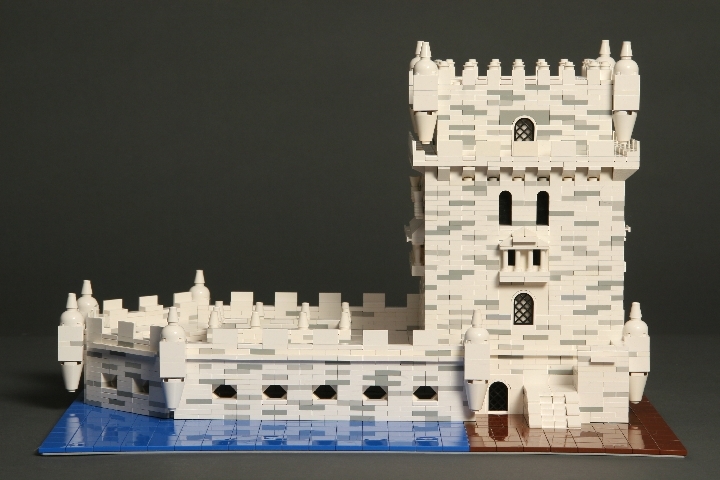
A Torre de Belém em Lego
Todas as imagens aqui.
Muitas maravilhas da arquitectura... Lego ;) aqui.
Master torgugick for Brickshelf, thanx!
sexta-feira, 7 de março de 2008
Why Do They Put Lead Paint in Toys?
Toy manufacturer Mattel recalled nearly 19 million Chinese-made toys Tuesday, including 436,000 toy cars containing lead paint. That was only two weeks after yanking nearly a million of its Fisher-Price toys for preschoolers because of lead content. Why would a toymaker ever use lead paint?
Because it's bright, durable, flexible, fast-drying, and cheap. Paint manufacturers mix in different lead compounds depending on the color of the paint. Lead chromates, for example, can enhance a yellow or orange hue. Municipal workers often use lead paint because it resists the color-dimming effects of ultraviolet light: The double yellow line in the middle of the road? That's loaded with lead. Paint manufacturers also add lead and other heavy metals to make paint stick better instead of flaking off. Price is also a factor: China mass-produces the stuff, and coloring agents like lead chromate are generally cheaper than organic pigments. (That said, added lead used to be a luxury. A house painter in the early 20th century would show up to a job with two buckets—one for the paint substrate, one for the lead powder. The more lead he added, the better the paint, the higher the price.)
Lead paint has other qualities that make it attractive to manufacturers. For one thing, it resists mildew, making it perfect for wood furniture and other surfaces likely to get wet. It's also anti-corrosive: Ship makers have historically applied a coating of lead paint, often containing the red mineral litharge, to the bottom of metal ships' hulls. (The Romans used lead paint, too—that's why the paint on some of their ruins is so well-preserved.)
But for all its utility, lead is dangerous even in small quantities. In 1978, the U.S. Consumer Product Safety Commission made it illegal to use any paint containing more than 0.06 percent lead for residential structures, hospitals, and children's products. But it's still widely used on bridges, tanks, towers, heavy equipment, parking lots, road signs, and other large-scale projects. There's still lead in most consumer paints, too—just much, much less. Many paint manufacturers now use safer alternatives like zinc, although it doesn't quite match lead's luster or strength.*
People have known about lead's harmful effects for centuries. Benjamin Franklin once wrote a letter about the "bad Effects of Lead taken inwardly," and some 19th-century paint companies ran newspaper ads bragging about their lead-free paint. President George H.W. Bush's dog, Millie, attracted national attention to the dangers of lead poisoning in 1992, when she got sick from breathing lead dust during White House renovations. In 2006, the state of Rhode Island won a lawsuit against three major paint companies, which were ordered to clean up 300,000 contaminated homes.
From Slate's Explainer
Isto sou eu agora
The Austin mother, who once had an "almost photographic" memory, began to stumble over friends' names when introducing them. She would hop in her car and forget where she wanted to go.
Massingill began to wonder about her brain, though, after she asked her friend if she was looking forward to her upcoming wedding. The friend reminded her the wedding had taken place a month ago — and Massingill was there.
Momnesia — the mental fuzziness and memory lapses that set in shortly after childbirth — had struck again.
"At first I thought it was about being really tired," says Massingill, 36, whose son, Mace, is now 7 months old. "I can't even remember the things I've forgotten. I really think motherhood does something to your brain."
Scientists agree. While researchers say they can't explain all the ways motherhood affects a woman's memory, they agree there's a pattern.
Like Massingill, many moms feel mentally foggy in the days after delivery. And they notice that the details of labor and delivery, which are scenes one might expect to be seared into a woman's consciousness, began to slowly slip away.
Sadly, Massingill says, her son's first few weeks of life have become a blur.
Few parents enjoy feeling so scatterbrained, says neuropsychiatrist Louann Brizendine, author of The Female Brain. And momnesia can be dangerous, such as when moms forget to fasten the straps in an infant's car seat. Yet momnesia may give modern mothers an evolutionary advantage, Brizendine says.
"It turns you into someone who serves that little infant, to keep it alive no matter what," says Brizendine, founder of the Women's and Teen Girls' Mood and Hormone Clinic at the University of California in San Francisco. "Other parts of your brain that are usually on high alert are sort of taken offline."
Women may be reluctant to talk about their memory problems for fear of being judged poorly at work, especially because returning to a demanding job puts even more stress on the brain, Brizendine says.
But women don't get dumber after childbirth. Instead, like sleep-deprived medical residents who learn on the job, their brains are getting a workout. "You are learning a lot," she says. "Once your mommy brain gets readjusted, you get more efficient, and you become smarter and learn things faster, but it won't happen all at once."
Mothers' priorities often change dramatically while caring for a baby. They need to be "hyper vigilant" about their infants, who may develop symptoms of illness that are apparent only to those who have scrutinized their every coo and cry, Brizendine says. "You're on the mother beat all the time. It requires certain parts of your brain to work hyper, hyper, hyper well. But it requires other parts of your brain to play second fiddle."
Hypervigilance in other areas
The cost of that vigilance can be a little ditziness, and that is a price many moms are willing to pay.
Amy Prather of Nampa, Idaho, for example, occasionally leaves wet laundry in the washing machine or forgets to return phone calls. But she also has learned to spot subtle signs of trouble in her 2½-year-old daughter, Faith, including a dangerous bowel obstruction that doctors initially dismissed as colic.
Elizabeth Singleton of Gig Harbor, Wash., has learned to react quickly when her 17-month-old daughter, Kiersten, is choking, partly because she has had so much practice. She estimates she has fished objects out of her baby's throat at least 20 times.
Yet she burned her favorite teapot by leaving it on the stove, and she still occasionally stores milk in the cupboard rather than the fridge, a mistake she typically discovers after the milk has spoiled.
When it comes to the pain of childbirth, a little amnesia is a good thing. The brain typically softens or erases memories of traumatic events to permit people to continue functioning.
Women whose memories of childbirth remain too vivid may suffer post-traumatic flashbacks, Brizendine says. "You remember the pain was really bad, but you can't get into that space," she says.
If women's memories of labor and delivery didn't fade, "we'd never have sex again," says Sharon Phelan, an obstetrician and gynecologist with the University of New Mexico School of Medicine.
Women's plummeting estrogen levels, which lurch from "incredibly high" in late pregnancy to "virtually non-existent" after delivery, can make it hard to focus. While estrogen plays a key role in fertility, it also acts as a neurotransmitter, sending signals in the brain.
Breast-feeding can prolong the mental haze, Brizendine says, by circulating hormones that help mothers relax and promote a "mellow, mildly unfocused" feeling. Massingill says she has been feeling slightly sharper since she stopped nursing her son a few weeks ago.
quinta-feira, 6 de março de 2008
Never give in, never, never, never
Every step may be fruitful.
Yet there will stretch out before you an ever-lengthening, ever-ascending, ever-improving path.
You know you will never get to the end of the journey.
But this, so far from discouraging, only adds to the joy and glory of the climb.
terça-feira, 26 de fevereiro de 2008
Babies are Angels
their wings disappear at the time of their birth,
one look in their eyes and we're never the same.
They're part of us now and that part has a name,
that part is your heart and a bond that won't sever,
our Babies are Angels, we love them forever.
From Grandma Angela, an angel herself ;)
How to make Apple Rabbits
To make an apple bunny, first cut an apple into eight wedges and remove the core. With a sharp knife, cut a shallow V-shape into the skin about an eighth of an inch deep. If you’re making a half-size miniature apple rabbit, first cut the apple wedge in half so it’s short, then score a V-shaped incision in the skin with the tips of the ears pointing towards the squared-off, cut end. I like to start the tips of the ears about two-thirds of the way up the apple to expose a little apple ‘body’, but that’s just personal preference. Play around!
O resto em Lunch in a Box
domingo, 17 de fevereiro de 2008
Copos e Narizes
Calling all party animals - here are the perfect beverage
cups to let you express your inner beast! Drinking from
these double- coated durable 9 oz cups turns anybody’s
nose into something WILD. Perfectly sized for both kids
and adults, each pack of Pick Your Nose/Party Animals
includes 24 cups in 6 assorted animal styles. The clear box
has a picture of an adult on one side and an adorable
youth on the other...clever huh?
From Fred & Friends ;)
quarta-feira, 6 de fevereiro de 2008
6 de Fevereiro / February 6th
terça-feira, 5 de fevereiro de 2008
Experts have plenty of advice for new parents. If only they could agree.
(...)
Feed the baby cereal with a spoon. Feed the baby cereal with your finger.
(...)
Consider the pacifier. "Most babies don't need them and are better off without," Penelope Leach declares. "Pacifiers," the American Academy of Pediatrics counters, "do not cause any medical or psychological problems."
Or the perilous issue of whether a baby should sleep with its parents. "Family beds do have snags and it's sensible to foresee them if you can so that you can weigh the pros and cons," Leach writes, on tiptoe. The American Academy of Pediatrics chooses its side by omitting "family bed" and "co-sleeping" from its index altogether; the Searses, partisans of love and attachment, present a bullying hard sell for cuddling through the night: "If there were fewer cribs, would there be fewer crib deaths?"»
(...)
sexta-feira, 1 de fevereiro de 2008
quarta-feira, 30 de janeiro de 2008
Arte em Papel: o Navio-Escola Sagres
Built in 1937 by Blohm & Voss in Hamburg, Germany, the Sagres II began life as a German Navy training vessel known as the Albert Leo Schlageter. Damaged in World War II, she was subsequently confiscated by the United States and given to Brazil, where she served through 1961 as a training vessel under the name Guanabara. Following a sale to the Portuguese Navy, she became the training vessel Sagres II, a role that continues through today. Her name comes from the Sagres Cape, the site of the world's first marine school, established by Prince Henry the Navigator in the 15th century. Its sails feature the Cross of Malta, which was emblazoned on sails of Portuguese vessels during the Age of Discovery.
Ahhhh, pois é ;)