E as emoções dos animais


On the vast arid plains of the Serengeti, the silent and deadly jaguar awaits his prey.

Victim in sight, he creeps slowly forward, his mighty paw raised for the killing stroke… and then…

WHUMP! "Oh, hi boss! I was just, ah… walking around the yard, minding my own business… you know, thinking about stuff… and definitely not stalking you, honest, I would never do that."

Rare jaguar cub born last year at Huachipa Zoo in Lima, Peru. Details here.
 E porque nesta casa há um iPhone, sei lá ;)


Texto dramático de forte pendor metafórico, Todos os Rapazes São Gatos é também um hino à liberdade e à irreverência da juventude, assim como à espontaneidade dos afectos, ao mesmo tempo que dá conta das dúvidas da personagem relativas ao seu crescimento e à sua auto-imagem. O simbolismo das referências felinas que dominam o protagonista e a forma como ele se relaciona com o mundo e com os outros excedem a sua simples caracterização e dão o mote para o desenvolvimento da acção. As ilustrações de Alain Corbel recuperam de forma original a metáfora que estrutura o texto, redimensionando-o. | Ana Margarida Ramos |
| Título Todos os rapazes são gatos | Autor(es) Álvaro Magalhães, Alain Corbel (ilustrador) | Tipo de documento Livro | Editora Edições Asa | Local Porto | Data de edição 2004 | Área Temática Infância, Afectos, Casa, Família, Animais, Linguagem, Sonho | ISBN 972-41-3582-9 | |

Finding out about Luke is a bit like tracing your family tree. Some of it is easy, because there is documentary proof, some of it is based on the fairly reliable evidence of what your parents and grandparents told you, and some of it has to be inferred, guessed and imagined. Luke was writing for someone who already knew him, Theophilus, and so he didn't bother to introduce himself. Books, in those days, were handwritten, not mass-produced, and though Theophilus probably had a few copies made for friends, all of them would have known either Luke or Theophilus, so no author's biography was necessary. In fact, he doesn't actually tell us his name at all. We know it because it always circulated as the work of one called Luke. The story Luke is telling is not about himself, though he was there to see parts of it, so uncovering Luke is a matter of piecing together scraps of evidence.
Although the name was quite a common one, ancient tradition has usually identified our Luke with the Luke whom the apostle Paul mentions twice. Paul is an important character in The Acts of the Apostles, and our writer does seem to have travelled with Paul on some of his missionary journeys. In fact we seem to have parts of Luke's travel diary reproduced in, for example, Acts 21, where the writer suddenly starts to talk about what "we" did, rather than using the third person narrative of the rest of the book.
So it would not be surprising if Paul's writings also mention Luke. In two of the letters of Paul that are preserved in the New Testament, Paul does indeed talk about Luke. In one letter, written to a man called Philemon, Paul adds greetings at the end of the letter from some of the other people who are with him. He says, in effect "and lots of love from Luke, too". He calls Luke his "fellow-worker", and though that is not exactly a recognised job-description, it does suggest someone whom Paul trusts and who is known, at least by reputation, to Philemon and other Christians.
The second mention is in a letter Paul wrote to the Colossian Christians. Again, Paul adds Luke's greetings at the end of the letter, and he calls Luke "the beloved physician". We know that Paul suffered from something that he called his "thorn in the flesh", and although there has been endless speculation about what exactly this might have been, it is possible that it was an ailment that made it helpful for him to have a doctor with him on some of his travels.
This is certainly how the Christians in the time immediately after the period in which the New Testament was being written knew Luke. The Muratorian Canon, which was an early list of important Christian writings, from around the end of the 2nd century, calls the author of Luke's Gospel and Acts "Luke the physician and companion of Paul". Irenaeus, who was bishop of Lyons at around the same time, also takes that for granted. So, clearly, wherever the manuscripts circulated, that explanation of their provenance circulated with them. That may sound unusual and unreliable to modern ears, but it is constitutes a high degree of certainty for a manuscript that comes from a culture where oral tradition and eye-witness accounts were the main form of historical record.
So much for the external evidence about Luke. His own writings tell us a little bit more. He writes really lovely, educated, fluent Greek. When he quotes the Jewish scriptures, which he does a lot, he is clearly using the Greek translation which we know as the Septuagint. He is well-read, and knows the conventions about how to write "proper" history, in a way that would be acceptable to his well-connected patron, Theophilus.
At the beginning of his gospel, he tells us that he has investigated everything carefully and written an "orderly account". He does not claim to have met Jesus, but he does claim to have used eye-witness statements about the events he is relating. Although he and Theophilus are both already believers, they are not credulous idiots. They want to know the evidence. Being a Christian at this period in history is not going to do anything for their social standing and is, at the very least, going to lose them friends among the educated, ruling Roman elite, so they need to go into this with their eyes open.
Luke's own personality only comes through very obliquely. He seems to have cared deeply for the poor and the marginalised – it is Luke who tells us that the first witnesses of the birth of Jesus are rough shepherds. All the gospels agree that women were unusually active and accepted in early Christianity, but it is Luke who preserves some of the best stories about them – for example, the story about Jesus' mother, Mary and Elizabeth, the mother of John the Baptist (Luke 1). Luke, more than any of the other gospel writers, notices that Jesus' mission was always potentially inclusive. In Acts, he chronicles how the Christian community grew so that it was no longer racially, culturally or socially exclusive, and you can't help wondering if that is one of the things that attracted him to it in the first place. This is a movement that starts with the small people.
All in all, I think Luke would have been a nice man to have dinner with. He would listen, without letting his eyes wander to find someone more important; he would talk wisely and well; he would make you feel that, however unimportant and mundane your life might appear, it could actually be part of some huge, exciting movement for change. That's what the story of Acts suggests.
From the How to believe series, The Guardian
HONG KONG (Reuters) - Children of older fathers appear to perform less well in intelligence tests during infancy and childhood, a study by researchers in Australia shows.
In contrast, the study found that children with older mothers tended to gain higher scores in the same tests designed to measure the ability to think and reason, including concentration, learning, memory, speaking and reading skills.
Men and women are having children later particularly in developed countries. But while the effects of having children later for women are widely discussed, consequences of increased paternal age are not as well known.
Recent studies have drawn links between older fathers and specific health problems in their children, including birth deformities and cancer, as well as neuropsychiatric conditions such as autism and schizophrenia.
In the study, the researchers analyzed data from intelligence tests taken by 33,437 children who were born between 1959 and 1965 in the United States.
The children were tested at 8 months, 4 years and 7 years and were assessed for their sensory discrimination, hand-eye coordination, reading, spelling and arithmetic ability.
They found that the older the father, the more likely the child would have lower scores on the various tests.
In contrast, the older the mother, the higher the scores of the child in the cognitive tests.
"Previous researchers have suggested that the children of older mothers may perform better because they experience a more nurturing home environment; if this is the case, this study suggests that children of older fathers do not necessarily experience the same benefit," the researchers wrote in a statement.
The researchers said the lower scores obtained by offspring of older men may have to do with mutation.
"Unlike a woman's eggs which are formed when she herself is in the womb, a man's sperm accumulates over his lifetime, which previous studies have suggested can mean increased incidence of mutations in the sperm at an older age," they wrote.

A baby may look helpless. It can’t walk, talk, think symbolically or overhaul the nation’s banking system. Yet as social emulsifiers go, nothing can beat a happily babbling baby. A baby is born knowing how to work the crowd. A toothless smile here, a musical squeal there, and even hard-nosed cynics grow soft in the head and weak in the knees.
In the view of the primatologist Sarah Blaffer Hrdy, the extraordinary social skills of an infant are at the heart of what makes us human. Through its ability to solicit and secure the attentive care not just of its mother but of many others in its sensory purview, a baby promotes many of the behaviors and emotions that we prize in ourselves and that often distinguish us from other animals, including a willingness to share, to cooperate with strangers, to relax one’s guard, uncurl one’s lip and widen one’s pronoun circle beyond the stifling confines of me, myself and mine.
As Dr. Hrdy argues in her latest book, “Mothers and Others: The Evolutionary Origins of Mutual Understanding,” which will be published by Harvard University Press in April, human babies are so outrageously dependent on their elders for such a long time that humanity would never have made it without a break from the great ape model of child-rearing. Chimpanzee and gorilla mothers are capable of rearing their offspring pretty much through their own powers, but human mothers are not.
Human beings evolved as cooperative breeders, says Dr. Hrdy, a reproductive strategy in which mothers are assisted by as-if mothers, or “allomothers,” individuals of either sex who help care for and feed the young. Most biologists would concur that humans have evolved the need for shared child care, but Dr. Hrdy takes it a step further, arguing that our status as cooperative breeders, rather than our exceptionally complex brains, helps explain many aspects of our temperament. Our relative pacifism, for example, or the expectation that we can fly from New York to Los Angeles without fear of personal dismemberment. Chimpanzees are pretty smart, but were you to board an airplane filled with chimpanzees, you “would be lucky to disembark with all 10 fingers and toes still attached,” Dr. Hrdy writes.
Our capacity to cooperate in groups, to empathize with others and to wonder what others are thinking and feeling — all these traits, Dr. Hrdy argues, probably arose in response to the selective pressures of being in a cooperatively breeding social group, and the need to trust and rely on others and be deemed trustworthy and reliable in turn. Babies became adorable and keen to make connections with every passing adult gaze. Mothers became willing to play pass the baby. Dr. Hrdy points out that mother chimpanzees and gorillas jealously hold on to their infants for the first six months or more of life. Other females may express real interest in the newborn, but the mother does not let go: you never know when one of those females will turn infanticidal, or be unwilling or unable to defend the young ape against an infanticidal male.
By contrast, human mothers in virtually every culture studied allow others to hold their babies from birth onward, to a greater or lesser extent depending on tradition. Among the !Kung foragers of the Kalahari, babies are held by a father, grandmother, older sibling or some other allomother maybe 25 percent of the time. Among the Efe foragers of Central Africa, babies spend 60 percent of their daylight hours being toted around by somebody other than their mother. In 87 percent of foraging societies, mothers sometimes suckle each other’s children, another remarkable display of social trust.
Dr. Hrdy wrote her book in part to counter what she sees as the reigning dogma among evolutionary scholars that humans evolved their extreme sociality and cooperative behavior to better compete with other humans. “I’m not comfortable accepting this idea that the origins of hypersociality can be found in warfare, or that in-group amity arose in the interest of out-group enmity,” she said in a telephone interview. Sure, humans have been notably violent and militaristic for the last 12,000 or so years, she said, when hunter-gatherers started settling down and defending territories, and populations started getting seriously dense. But before then? There weren’t enough people around to wage wars. By the latest estimates, the average population size during the hundreds of thousands of years of human evolution that preceded the Neolithic Age may have been around 2,000 breeding adults. “What would humans have been fighting over?” Dr. Hrdy said. “They were too busy trying to keep themselves and their children alive.”
Dr. Hrdy also argues that our human ancestors became emotionally modern long before the human brain had reached its current average volume of 1,300 cubic centimeters, which is about three times the size of a chimpanzee brain — in other words, that we became the nicest apes before becoming the smartest. You don’t need a bulging brain to evolve cooperative breeding. Many species of birds breed cooperatively, as do lions, rats, meerkats, wolves and marmosets, among others. But to become a cooperatively breeding ape, and to persuade a bunch of smart, hot-tempered, suspicious, politically cunning primates to start sharing child care and provisionings, now that took a novel evolutionary development, the advent of this thing called trust.
To explain the rise of cooperative breeding among our forebears, Dr. Hrdy synthesizes an array of new research in anthropology, genetics, infant development, comparative biology. She notes that recent research has overturned the longstanding insistence that humans are a patrilocal species, that is, with women moving away from their birth families to join their husbands. Instead, it seems that young mothers in many traditional societies have their own mothers and other female relatives close at hand, and who better to trust with baby care than your mom or your aunt? New studies have also shown the importance of postmenopausal women to gathering roots and tubers, the sort of unsexy foods that are difficult to disinter and lack the succulent status of, say, a freshly killed oryx, but that just may help feed the kids in hard times. Other anthropologists have made the startling discovery that children have entertainment value, and that among traditional cultures without television or Internet access, a bobble-headed baby is the best show in town.

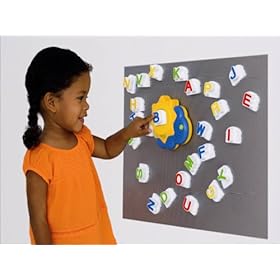
- Lights follow letters to reinforce the learning
- Helps develop rhyming skills and teach word building for three-letter words.
- Features big, bright letters that are easy for little fingers to grasp to help develop fine motor skills
- Playful phonics songs help children remember the sound each letter makes.

Nobody goes hungry for learning with this set of 26 colorful, easy-grip magnetic letters and magnetic letter reader that attaches securely to your fridge. Each letter talks, sings and teaches letter names, letter sounds and learning songs. Put a letter into the reader to hear its name, its sound or a fun phonics song.
Your kids might not eat their vegetables, but with the Fridge Phonics Magnetic Set they can learn to spell them.



A KidZania tem uma economia e uma moeda própria: o KidZo Esta economia permite às crianças fazerem a gestão do seu próprio dinheiro, tomar decisões quanto à sua aplicação e entenderem a importância do dinheiro e do trabalho no dia-a-dia dos adultos.
|
 | Fazem as suas primeiras poupanças através da abertura de uma conta bancária no banco da cidade. |
| O dinheiro da sua conta pode assim ser levantado no banco local ou numa ATM da cidade de cada vez que as crianças regressam à cidade. |